
Soma Dao Qi Gong Courses – 2026
This course is for those who want to go in-depth into the Foundations of Qi Gong and want to become a Traditional Qi Gong Instructor.
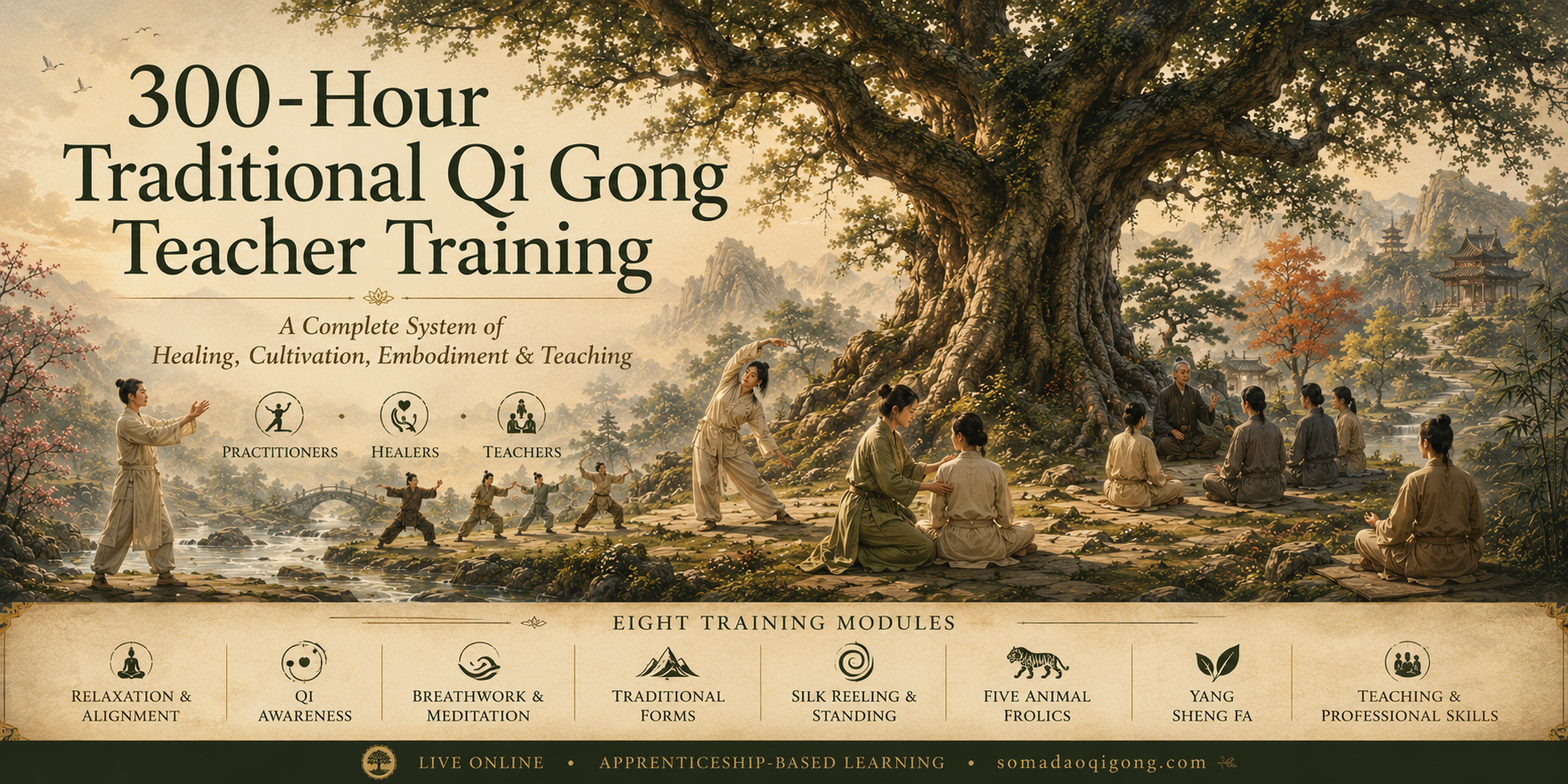
Qi Gong focuses on connecting with your Qi, or your ‘Sensations of Aliveness’, entering deep states of meditation, instinctual readiness, emotional acceptance, and Spiritual reunion. Skills that almost everyone needs more of today.
Learn in a traditional lineage that combines Shaolin and Daoist Qi Gong, rooted in Traditional Chinese medicine.
Here is your homework…
Practice Awareness, Adaptability, Flow, Resilience, Release, and Stillness.
Course Overview
Module One - Qi Gong for Relaxation, Flexibility, and Inner Alignment
In Qi Gong, we begin with Relaxation, Flexibility, and Inner Alignment
Relaxation is an Instinctual Need
If you want to relax right now, HERE is a Breathing Exercise.
There is a reason why the oldest traditions of Embodiment practices like Qi Gong, Yoga, Shamanic Dance, Singing, Drumming, Fasting, and Meditating alone in Nature have existed for so long.
Our Bodies and Minds NEED times of open, silent, tranquil, and restorative ease.
Flexibility and Tensegrity
The tone and health of your muscles and connective tissues can determine your Vitality and Longevity, more than many other influences. Qi Gong focuses more on pliability, torsion, alignment, and release, instead of trying to stretch too far.
“The hard and stiff are death's companions. The soft and supple are life's companions.” – Dao De Jing, Verse 76
Inner Alignment
Like moving towards the eye off a hurricane for safety, Qi Gong encourages finding a centered, aligned, and somewhat resolute quality of stillness. As well, most practices bring your awareness of your many centers of movement, instinct, emotion, and existential truth.
‘Go dancing and find out where the center of your unique dancing comes from.’
Module One Contents:
Stand Like A Mountain, Bend Like Bamboo, Flow like Kelp in the Ocean
- Qi Gong practices for opening your arms, shoulders, and neck
- Tai Chi exercises to reconnect and coordinate your waist and hips
- The Five Pillars of Standing Qi Gong
- Introductory Animal Play and Shapeshifting
- Floor Work - Reactivating your core, realigning your spine, stretching your whole body
- Improving pelvic floor tone
- The principles and practices of Standing and Seated meditation
- Seated versions of the fundamental exercises
- Fundamentals of Breathwork
- The subtle art of progressive relaxation
- understanding Qi
- Qi Gong philosophy and Wisdom Teachings
Module Two - Cultivating Qi Awareness and Sensitivity
Qi Gong, as you probably expect, is going to introduce you to another way of experiencing the world.
In the endeavors of healing, spiritual reunion, or developing martial arts skills, a direct and tangible relationship with Qi is necessary. You will learn the skills used by Chinese medicine practitioners and warrior monks to connect with the Qi of your Body and the Qi of the Natural world. As well, Qi Gong can help you focus on applying Qi towards your health and happiness. With practice, you will encounter new experiential realms and ways of interacting with the subtle influences in Life and the Universe.
Connecting with Qi
Have you ever listened to the space between the flash of lightening and the sound of thunder…?
Feeling into your physicality, somatic experience, and intuition is a doorway to many things, such as Self-Regulation, being able to relax completely, and embodied or Somato-Emotional Intelligence. You just need a regular and deeply engaging practice.
We all need a practice. If you want more than basic fitness and comfort, find a teacher with a clear, practical, and meaningful (to you) process of learning embodied awareness.
Relearn how to breathe. Fall back in love with stillness and silence. Dance like your Ancestors are watching!
Module Two Contents:
- Cultivating Qi sensitivity and the origin of the Inner smile
- Cultivating your three Dan Tian , energy gates and access points
- Standing Qi Gong Warm Up
- Generating a Qi Ball (La and Na - Pulling Open, Pressing Closed)
- Transforming your Sacred Qi Cauldron
- Cultivating interactive awareness (yi nian)
- The Balancing heaven and earth Qi Gong form
- Clearing turbid Qi and Bathing in Pure primordial Qi
- The Four Oceans of Dao
- Seated versions of the fundamental practices
- Tracing and Clearing Your Microcosmic Orbit
- Lying Qi Gong for relaxation, deeper sleep and dream healing
- Balancing your Three treasures and three regulations
- Daoist cosmology and ontology
- Qi Physiology and Aliveness
- Qi Wounds and Qi Deviation
Module Three - Seated Qi Gong, Breathwork, and Daoist Meditation
An important principle in Qi Gong is ‘Stillness in Motion.’
In life, sometimes the slower and more present you are, is what matters the most. Research shows that calm and alert states of stillness and silence can help your nervous system reset itself, and for your brain to physically regenerate itself. Seated Qi Gong and Meditation are an essential aspect of cultivating longevity.
Module Three Contents:
Have a Seat - Why seated Qi Gong is Essential (Especially for Modern Teachers)
- Office chair embodiment resets
- State Shift and Shapeshifting skills to rediscover animistic wholeness
- The Ten pillars of seated qi gong
- Qi Gong for rehabilitation
The four branches of Breathwork (list)
- Natural Breathing (Shun Hu Xi)
- Reverse Breathing (Ni Hu Xi)
- Vase Breathing
- Sensual Breathing
- Nei Qiang (Inner Flexible Vessel) Breathing
- Spontaneous/unrehearsed Breathing (Zi Ran Hu Xi)
- Underwater Breathing
- Water Surface Breathing
- Water Stalking Breathing
- Pore Breathing
- Bellows Breathing
- Tortoise Breathing
Seated Meditation
- The Barrier of Sitting and the Three narrow passes of the spine
- The 3 moments of Chan/Zen Meditation
- Introductory Daoist Inner Cultivation (Nei Gong)
- Introductory Self Healing (Nei Yang Gong) skills
Module Four - Applied Principles and Traditional Forms
Falling in Love with Repetition, Flow, Connection, and Meaning
Traditional Qi Gong forms, or choreographed routines are the most popular on common aspect of modern Qi Gong practice. Falling in love with repetition is the best way to include and refine the internal awareness practices and principles of more advanced Qi Gong training.
Module Four Contents:
Qi Gong Principles
- The three Treasures
- The three regulations
- Your Three Selves
- The Three Basins
- The Four Layers of Interaction
- The Five Pillars of Qi Gong
- Ting Jin – The Power of Listening
- Opening the Kua System
- Fundamentals of the Yi Jin Jing (Fascial Tensegrity)
- Your Inner Landscape (Nei Jing)
- Your Five Spines
- States of Being and State Shift
- Ba Gua circle Walking Qi Gong
- Daoist Principles of Conscious Becoming
Selected Qi Gong forms
- Balancing Between the Sky and Land (Tian Di He Yi Fa)
- 8 pieces of Brocade (Ba Duan Jin) (For Kids)
- Ba Duan Jin (Shaolin version)
- Ba Duan Jin (Daoist Swimming Dragon version)
- Tai Chi 18 gesture qi gong (Taiji Shibashi) First sequence
Module Five - Silk Reeling and Standing Meditation
This Module focuses on Qi Gong practices that, not only take your practice deeper inward, but also help your structural alignment. Standing in static postures has also been shown to lower blood pressure, improve memory and focus, as well as build and maintain stronger bones.
Module Five Contents:
- Qi Gong routine for Agility and Balance
- Joint Pliability and Tone Review
- What is Silk Reeling (Chan Si Jin)?
- The Eight Core Silk Reeling gestures
- Exercises to connect your shoulders and hips
- To coordinate your elbows and knees
- Moving from your center through your fingers and eyes
- The Inner Art of Standing Meditation (Zhan Zhuang)
- The 8 primary postures
- The 16 inner refinements of Zhan Zhuang
- An introduction to Yi Quan
- 100 Days of Meditation – A Traditional Rite of Passage and Progress
Module Six - Five Animal Frolics - Old and New
Five Animal Frolics, or State Shift and Shape-Shifting Qi Gong has a very long history of imitating animals. Being playful, becoming a Dragon or a Monkey, and allowing your body to dream it has infinite possibilities is very good for your Spirit. Breathing with intention, until you feel altered enough to see the Universe as a friend is also very good for your Spirit.
The famous TCM doctor Hua Tuo formalized this ancient Indigenous practice almost 2,000 years ago. Dr. Hua Tuo was also the first Chinese medicine surgeon, being the first in the world to developed the use of anesthesia, and furthered the knowledge of anatomy.
Hua Tuo's incredible life ended at age 97 by being poisoned by a jealous official. His primary student lived to be well over 100 years old. in an unfortunate manner.
Five Animal Frolics is one of the oldest forms of Qi Gong is imitating and playing like an animal. This opportunity to lose yourself while turning into a Panther, Bear, Tortoise, Ape, or Phoenix can connect you with some deeper instincts and free you from feeling stuck – on many many levels. These forms can be practiced slowly like Tai Chi or with the agility of a martial artist. The more you challenge your agility, balance, and coordination; while keeping your muscles and tendons toned and pliable the longer you will live. More importantly, the more alert and physically fit you can be up until your last days of Life.
Module Six Contents:
- Animal Frolics and the Origins of Qi Gong
- Shapeshifting and State of Being
- The Classic Five Animals (Deer Dragon, Tiger, Monkey, Crane
- Inner Nature and Outer Aliveness
- Standing Frolics
- Seated Frolics
- Sky Frolics
- Becoming An Iridescent Panther
- Becoming A Black Bear
- Becoming A Red Phoenix
- Becoming A White Ape
- Becoming A Golden Turtle
Longevity practices should bring aliveness, playfulness, and gratitude into a very long and healthy life.
NEVER stop Playing!
Module Seven - Cultivating Vitality and Longevity (Yang Sheng Fa)
The Chinese characters for Yang Sheng Fa (養生法) describe feeding your leftovers to your goat, just in case you need to eat your goat to stay alive. Some aspects of Chinese philosophy are very pragmatic. Said another way, Yang Sheng Fa is a lifelong daily practice of self-care that involves all aspects of your life, even the humble and seemingly unimportant things. This approach to living a conscious and healthy life is more about flow and seasonal alignment.
The Yang Sheng Tradition can be described as Chinese Medicine 101 – if you are ill and want to understand how to get healthy, you need to know what went wrong. To understand what went wrong, you need an understanding of how your internal organs, glands, metabolic and immune systems, and your circulation works.
Becoming a Professional Qi Gong teacher is about both, the ability to be more specific, and the ability to speak to the broadest and most impactful challenges of our time. Because I am speaking about becoming a health care professional, even if it is just for yourself, your family, and friends, I want to encourage you to keep learning about health.
Module Seven Contents:
The Yang Sheng Tradition of TCM
- The Four Constitutions and The Five Taxations
- A Seasonal Diet
- Metabolic and Spiritual Fasting
- Seasonal Fitness strategies for young and old
- Mental and Emotional Hygiene
- Conscious Parenting
- Sacred Intimacy
The Ten Steps to Abundant Health
- Start with the Do’s, Work on the Don’ts
- Design Your Personal Health Journey
- Get Enough Sleep, Rest, and Play
- Fitness, Fat Loss, and Fasting Strategies
- Stabilize Your Metabolism (Jing and Shen)
- All Disease Starts in Your Gut
- Resetting Your Immune System
- Support Your Liver’s Detoxification Pathways
- Increasing Elimination and Circulation
- Restore Your 60 Trillion Cells
Module Eight - Higher Levels, Teaching Skills, Professionalism, and Modern Marketing
In this final Module, we will spend some time having a conversation and learning about the more advanced practices of Qi Gong, Dao Yin, and Inner Cultivation (Nei Gong).
Nei Gong Meditation and Your Six Innate Minds (Yuan Xin)–Nei Gong is a life-long path of meditation and learning to become a more adaptable and present human being. If there is one final attribute to add to your Traditional Qi Gong training, it is to find some guiding wisdom and Spiritual practices to cultivate an agile and self-aware Mind, as well as a collaboration of your instinctual, intuitive, adaptive, feeling, egoic, and existential Minds.
I will also offer additional Webinars on the teaching process for any sport or skill, the ethics of teaching a Spiritual practice to those in a vulnerable place, and what I have learned about beginning and building your online presence.
Nei Gong ~ Daoist Inner Cultivation
Opening Your Meridians and Dan Tian
Begins Oct 21, 2026
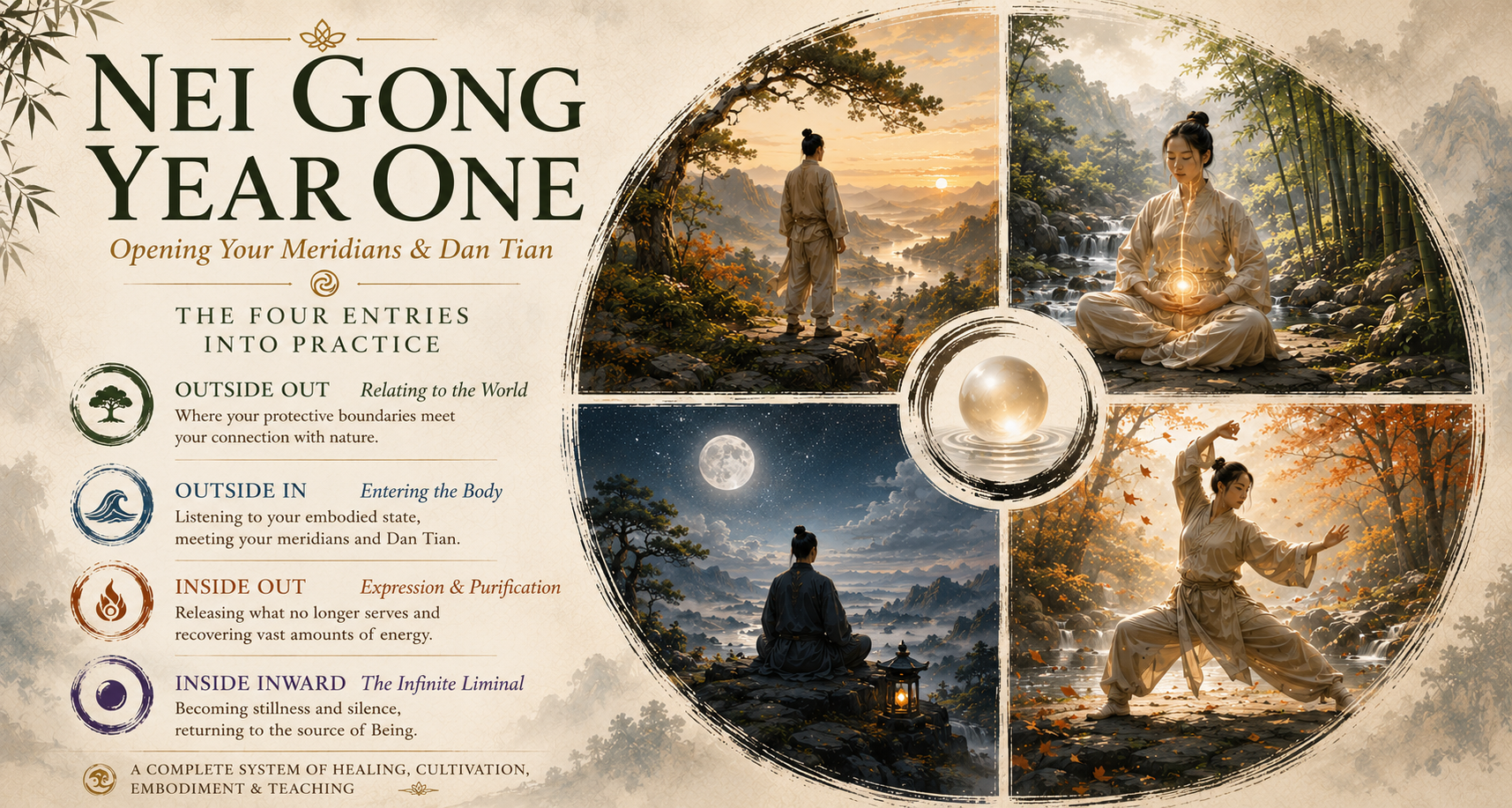
Outside Outward — Balancing Connection and Protection
Protection, Projection, and Relating to Your Environment
We are all the result of how we have adapted to our environment.
Your adaptive capacity and style are your ‘vibe,’ and also an expression of your Shen and Qi, and how you consciously and unconsciously use your Jing.
To shift out of survival mode, you must meet your protective exterior, and find the truths and tools to navigate all that is outwards – skillfully.
Skillfully enough to drop your guard consciously and slowly - the way you would soothe a wild animal. This can be especially gradual for Martial artists, those living with addiction or trauma, and other Warriors like neurodivergent humans navigating a neurotypical world.
In practice, acknowledge that your environment, and your adaptive responses are free to change.
Is your adaptive state of distress able to shift into a soft and open curiosity?
Once more, is your adaptive state of distress able to shift into a soft and open curiosity?
Wait there…
Before beginning practice, notice the space around you.
Do you need to adjust it—cleanse it, simplify it, state an intention, or create a better sense of support?
If you are indoors, how much of the natural world is visible when you look out a window?
Does the space feel conducive to what you consider Sacred?
As we enter into this ‘outside outward’ relationship, we need to separate the clear and turbid, enter the felt sense moment, move attention away from the stories about the past and future, and come into a state of calm and open curiosity.
A part of Nei Gong practice is creating is a liminal state of Being, which is becoming open to imminent transformation and insight.
Sometimes, a person new to Nei Gong finds that their inner resolve (called Zheng Qi) and external hackles (called Wei Qi) can be stuck, tired, or frustrated. If the ways we protect ourselves and solve problems loses agility and spontaneity, then the journey of becoming a whole self loses agility and spontaneity. This is why standing movements and playing with dynamic states of alertness, reaction, and release change us from the outside inwards.
As we begin to relate to our response patterns more authentically, we can lower our proverbial periscope of vigilance, and we can lower our guard from immanent threat. An often-imagined threat that is held in a Mind experiencing adaptive overwhelm.
Imagine yourself as an animal.
Let’s try some embodied alertness with an animal’s Inner Cultivation.
Be playful if you are willing.
These questions help orient attention to your External World.
- What has your survival hackles up?
- What has your social hackles and antennas worried about belonging or fitting in?
- What makes you guarded, burdened, defensive, overwhelmed, or tense?
- If you had claws, what would you be scratching at, keeping at bay, or clutching too tightly?
- If you had insect-like antennae, what would they be sensing for?
- What needs still need to be met?
These images help us feel our instinctive patterning. They reveal how your nervous system meets the world before thought and skillfulness have had time to get organized.
Acknowledge that your responses are free to change.
What helps you feel focused, safe, and connected in a healthy way?
As you become centered and calm, your ‘outside out’ entry is almost complete.
What is happening in the environment, season, lunar cycle, weather around you?
Arriving completely included remembering that Qi is surrounding you at all times, and there are many ways to connect with nature, the Land and Sky, and ways to be imbued with Dao.
Below are several examples of Qi Gong, Dao Yin, Nei Gong, and Meditation (Nei Ye).
Outside Out Practices
Clearing boundaries and restoring your innate connection
Fang Song – is a series of principles for unravelling your default embodied state of being, while learning the innate pattern of the Relaxation Response.
Five Elements Qi Gong Forms – All phenomena Come into Being on the spectrum of the Five Phases. This encourages both self-regulation and self-expression).
Tree Qi Gong is a very old Daoist practice called Gathering Transmuted Essence of the Sun and Moon 採日月精華 (cǎi rì yuè jīng huá) which holds a unique junction between contemporary Nei Gong and Shang Qing animistic embodied meditation. Another translation would be ‘harvest essence through imitating or becoming any living thing between Yin and Yang.’
Imitating the aliveness (Qi) of a tree through a night and day cycle, or through the rhythm of the seasons is a very effective entry into Nei Gong awareness.
The Big Regulation Form – (Tai Li Fa 太利法) – animisticaly explore and express a reunion with the cycles of nature, and with all of the Beings, Influences, and Spirits in Nature.
Restoring Harmony between the Land and Sky Form – (Tian Di He Yi Fa 天地合一法) energetically become the Qi of the Sky/Heaven and the Land/Earth. This generates a lot of Qi and helps bring balance to Yin and Yang, Jing and Shen.
Speaking of Nature, and remembering the wisdom of ‘As above, so below,’ it is good to have a knowledge base about the universe around you. As a part of this tradition, you will also learn, Daoist Cosmology, Ontology, and Divination ~ (Yu Zhuo Ling Zhi 宇宙靈棋) as well as Seasonal Naturalism and Environmental Harmony ~ Ri Yue Feng Shui 日月風水.
Reading the Daoist classics will help you enter into the Inner Cultivation worldview.
Translations of the Nei Ye (Inner Liminal Endeavor) and the Nei Jing Tu (Inner Landscape Scroll) are a part of this training.
Outside Inward — Becoming Your Embodied Experience
Entering your Embodied State
Once you are free to respond, learn, and play, you begin moving from the outside inward.
Arriving inward, listen to your felt sense, your posture and breath, your embodied memories, your unfinished instincts, and your present state.
In stillness, you will experience a lot of sensations. Some days you may notice a knot in your stomach, a tension in your throat, a flutter of anxiety, the softness of calm, the dissolution of tranquility, the ecstasy of reunion, the ups and downs of caffeine, grief, anticipation, and countless other internally generated states.
In many ways, this movement from outside in is an initiation. It requires authenticity, willingness, patience, and discernment. It often brings us into contact with what I call speed bumps and off-ramps.
Speed Bumps
A speed bump is a place where we encounter something we do not want to feel. A sensation may trigger anger, shame, grief, fear, or a latent memory. Often, when we hit a speedbump we dissociate into fantasy. Until acceptance replaces control, it feels necessary to stop, turn away, or brace. I use the term speed bumps because at every new internal encounter, it is important to slow down, feel into all aspects of the experience, and wait long enough to understand as completely as possible.
Many early healing and cultivation systems are deeply concerned with clearing this inner landscape. Before cultivating this landscape, we must prepare the Soil of the Mind and Body.
Off-Ramps
An off-ramp is more dangerous. It happens when sensation, memory, or meaning begins to pull us away from grounded practice into distortion, inflation, or life consuming delusion. As buried energies become free, some practitioners may become identified with power, or begin constructing special identities around money, sex, and power. This can lead to profound Qi deviations, which are experienced as psychological, emotional, and spiritual disorientations.
Every meditation tradition includes warnings about this
Some never fully return from those detours…
Moving from the outside in requires maturity and patience, and a bit of healthy skepticism. It asks us to allow for unexpected states of distress or bliss to arise within one’s field of awareness - without becoming consumed by them.
Off-ramps feel like opportunities for release, learning, and growth, but are most often pathways to delusion.
Cultivating Your Inner Landscape
An important part of moving from outside in is learning the inner terrain. Depending on the tradition, this may include posture, alignment, joint balance, tissue length and tone, circulation, breathing membranes, meridians, organs, energy centers, extraordinary channels, and larger cosmological layers of energy and consciousness.
In the first year, it is wise to engage in a process called Bu Que 補闕 which means to repair and restore a fracture or rupture that created a Qi wound or a disorientation of adaptability and Spirit.
There are some powerful Dao Yin practices that move people through this process consistently, that are also used to learn other inner cultivation principles. To arrive on the inside, simply drop your guard, hold Sacred Space, and begin the restoration and purification process. Most of these practices are expressive, immersive, fulfilling in a way that brings a regenerative state of satisfaction and meaning.
In this Daoist medicine tradition, this often means learning how meridians feel in your body, how they relate to your organs, how tissues are systems and ‘Spirits,’ and how centers such as the Dan Tian determine the consistency of practice and progress. As well, becoming your Microcosmic Orbit (which takes a year), changes the foundation of how you practice.
In allowing the outside inward, it is inevitable to experience a wider universe in which body, nature, and spirit are not separate.
Eventually, the boundary between Self and World becomes more permeable. If you practice in a meadow, among trees, beside a large rock, under the Sky, something in you remembers that inner cultivation includes a profound sensitivity to shifts in the natural world.
Becoming the Land and becoming True Soil are necessary for the foundation to begin. True Soil (Zhēn Tǔ 真土) is a pre alchemic state.
As the animistic teachers remind us, ‘As above, so below.’
This is one of the great aspirations of practice: to experience the reunion of one’s inward authentic nature, coming home to the nature of existence.
As I mentioned earlier, at first, it is best to experience your whole body and every quality of your embodied state as your Dan Tian.
If your Nei Gong approach is complete, you will transform your stagnant energies, tissues, fluids, and meridians, into a living and intelligent antenna connected to the fields around you. Your meridians are connected through a kind of liquid crystal internet made of every tissue in your body. It is referred to as an antenna because all forms of plasma have the capacity to interact with bio-magnetic and electrical frequencies.
All antennas need to be tuned, and all batteries need to be charged.
As your Three Treasures (Jing, Qi, Shen) become fulfilled and balanced, the process of refining your Jing/Essence can begin in earnest.
This purification happens through a tranquility practice called Qing Jing – or Tranquil Purification, or Coherent Tranquility.
In the second year, the aspiration shifts from Bu Que – (Healing Wound and Restoring your Inner Landscape), to Fàng Qì 放氣, which means, ‘release, free, liberate through Spiritual reunion, dissolution, and absorption.’
Arriving inward from any relative outside, through some tangible boundary, is the essential meaning of Nei 內.
Practices for Entering Your Embodied State
Exploring and Refining Attention and Perception (Gan Qi, C’an Qi and, De Qi) is at the root of Nei Gong practice. With some perceptual training you will cultivate Tīng Jìn 聽勁 (the skill of listening with your whole body and being), and Yì Niàn 意念 (the skill of Coherent Interactive Awareness).
On the journey from the outside inward, embodied awareness and subtle interaction practices like Dao Yin 導引 are essential. Joint opening exercises and traditional forms keep your inner landscape and energy systems open, free of stagnation, and full of vitality.
This initial training in the principles of embodied practice, structure, alignment, coordination, breathing, aligned stillness, and tensegrity are good for your longevity, and to ensure efficient Qi circulation, and harmonious tissue systems.
All tissues (skin, flesh, vessels, tendons, bones,) are necessary for abundant Jing.
Standing Meditation (Zhan Zhuang 站樁) is one the most transformational forms of Nei Gong, in the short term and the long term. For learning inner principles, this practice is best described as the attrition of bad habits. Efficiency is found through investigating (or enduring) inefficiency.
Your embodied state, your progress, and your efficiency in standing completely still, while also melting like wax, generates and recovers a lot of Qi – as present aliveness and for a long life.
The Yi Jin Jing – 易筋經 system of Shaolin Nei Gong is by far the most demanding and the most powerfully beneficial series of interactive principles and exercises. The refinement of pandiculation, tensegrity, and the profound transformation of your muscles, tendons, membranes fascia, and gel-like fluids, is unlike any other practice in the world. We touch on the Yi Jin Jing in this course, for more on comprehensive Shaolin training, see this website.
Your embodied state takes on another dimension of existence through the Willow Dance, a Dao Yin form for cultivating Meridian awareness. This beautiful and flowing practice has many applications and benefits – externally and internally.
Breathwork and Qi Cultivation ~ Tu Na Hu Xi 吐納呼吸. How you receive every breath is an opportunity receive the Qi of the day and release any noxious qualities of existence. Breathwork is a guide through your inner membrane system, many layers of unconscious reflexes, and rhythms that allow your practice to deepen.
Breath Circulation Inscription ~ Xing Qi Yu Pei Ming 行氣玉佩铭. The first teaching on guided breathwork was found on a jade pendant that was made at the same time, and possibly in the same place, as the Inner Liminal Endeavor (Nei Ye). This 45-character rhymed explanation entitled Xíng Qì行氣 or "circulating the (vital) breath" is one of the clearest descriptions of applying breathwork towards inducing a profoundly coherent and interactive embodied state.
Primordial Qi Gong is a modern expression of a much older Daoist Inner Nourishing form that focuses on activating your Three Dan Tian and your Three Basins of movement and dynamic physical power (Fā Jìn 發勁). The journey from the embodied play of your Three Basins to the subtle and elusive experience of your Dan Tian is a perfect mirror and guide for your inward journey.
There are many Seated Nei Gong practices that help you settle your existence inward. Then you will gradually reinhabit your Three Dan Tian.
Sometimes allowing external energies to move into and through your body awakens a protective reflex. Being gentle and slow is more beneficial. Allowing energetic exchanges to happen, one meridian system at a time, feels more like co-regulation than being ‘pulled apart’ or ‘blown open.’
Everyone is unique, and what is needed to restore inner harmony asks each of us to develop an individual practice.
There are also seated and lying practices for opening your spine, and cleansing and restoring your physical body, and energy body, and your many tissue bodies. Energetic awareness develops and improves as you become more at ease from the outside outward and more self aware from the outside inward.
Once at home within, you may need to move some wounds and ghosts from the inside out.
Inside Outward — Purification and Release
Expression, Purification, and Realignment
Once you have entered your inner landscape and embodied state, and once you have become your Dan Tian, the next entry into Nei Gong is moving Qi from the inside out. This is the domain of purification through release, and through acceptance of Existence as itself.
For some, this happens quickly and only lasts for a short time. For others, it can be a lifelong journey.
This is the path of finding the center within the center (Nei 內) and truly and completely letting go through the final boundary…
This shift of energy happens through stillness, waiting, movement, sound, breath, art, emotional work, ceremony, relational practice, and conscious expression.
Sometimes purification comes through tranquility and the slow attrition of distraction and compulsion.
Sometimes, observing your experience with authenticity and autonomy can show your inner yearnings, truths about Existence, and deeper interactions with your meridians and Dan Tian, that may not have been found any other way. The purification of releasing happens through a combination of Coherent Interaction (You Wei), Tranquility (Qing Jing), and Non-Being (Wu Wei).
In Nei Ye practice, this process is referred to as Cleansing your lodge.
“Reverently cleanse one’s dwelling, the vital essence will come of itself.
Jìng chú qí shè, jīng jiāng zì lái.
敬除其舍,精將自來。
Practices for Expression, Purification, and Realignment
Dao Yin - Dissolving through Progressive Release and Conscious Breathwork. This is a skillful approach to unravelling constraint and the ‘keep it together of life,’ while also expressing and restoring your innate aliveness.
Instead of constraint, sometimes we find areas of ‘emptiness’ or collapse that need to be restored through rest and through ritual like practices with your meridians, internal organs, the Sun, Moon, Seasons, the Land, powerful places, and time itself.
Breathwork - Many inner cultivation traditions also include periods of Purification and Release through State Shift Breathwork. This sacred practice can induce laughter, crying, a trance state or even hallucinations. Dissolving existential boundaries releases internal blockages. Daoism has a long history of ecstatic release and reunion practices.
Other forms of Breathwork, like Nei Qiang Breathing focus on the reunification of every diaphragm, muscle, and membrane involved in whole body breathing.
Seated Inner Nourishing Skills (Nei Yang Gong) practices retrain your diaphragm, your perineal floor muscles, and your tongue to restore internal integrity. This practice also involves restoring the Spiritual Virtue (De) of each of the five primary organs, as well as a gateway in your chest called the Yellow Court (Huáng Tíng 黃庭).
The Four Seas of TCM and the Four Oceans of Dao.
For many people, it is hard to let things out because they do not want to harm or impose on others. These practices help you build a potent and trusting relationship with your environment and also feel into your sense of resourcefulness and availability.
Three Dan Tian Meditation helps you clear energy, thought forms, and some would say ‘ghost like’ remnants of ancestors and painful relationships from your Soul(s) and potentially your genes.
The third entry into practice, allowing your inner experience to expel agitation and express its needs is the gateway to a non-constrained Mind. There comes a time when training your Mind needs to move beyond Coherent Interactive Awareness (Yi Nian) into Guarding Attention/Intent (Shǒu Yì 守意).This practice is developed through a series of practices called Inner and Outer Listening and Seeing.
One of unique aspects of this tradition is the Six Innate Minds (Yuan Xin 原心). This is an understanding that recognizes each Dan Tian has innate conscious and unconscious capacities and drives, some drives are existential, some instinctual, and some relational.
Reuniting these often-unconscious and compelling ‘Minds’ opens your attention to a unique capacity for coherence in meditation – and to develop a sense of humor with the voices in your head. The ‘Innate Minds’ are not literally thought of as structures but as essential relationships, sources of meaning, and qualities of life.
Zhōng Xīn 忠心 – Wholeheartedly Always Centered in Your Heart/Mind - When your Mind(s) can attend to all of your senses, and all of your ‘Innate Minds,’ without distraction, contemplation, or evaluation, you will cultivate the advanced meditation skill called Guarding the One Shǒu Yī 守一.
Lying Dao Yin and Breathwork. Imagine lying at peace, residing in restful ease, restored, and ready to leap wholeheartedly into a profound undoing. It is now possible to enter through the mystery gate that is waiting at the source of Being and Becoming.
Inside Inward — The Infinite Liminal Endeavor
Nei Ye ~ 內業
The Infinite Liminal Endeavor
The fourth and deepest entry into practice and reunion with existence is a journey from the inside inward.
This experience is harder to speak about directly, because it occurs beyond the bounds of ordinary language. Yet, traditions have always approached this layer of practice through recognizable methods, classic historical texts, contemporary metaphors, and memorable stories. Once the practitioner has developed sufficient grounding, embodiment, purification, and coherence, deeper work becomes possible.
This transition occurs in the alchemic state called True Soil (Zhēn Tǔ 真土).
On the Inward Journey Several Pathways Appear
內業
Nei Ye 內業 – Inner/Infinite Liminal Endeavor
Nei Ye describes the experience of moving from the outside to the inside of a bounded space - while always moving towards inward openings (Nei), and a practice, , or a watchtower from which you can look out (Ye), or reach out energetically to encounter vaster truths and realities through cycles of spontaneous illumination and reunion with an Un-nameable Mystery Beyond Infinite Emptiness (Xuan Xuan).
想
Xiang 想 - Visualization /Invocation/Actualization
Visualization is natural. It is simply the mind imagining a process, a memory, an artistic image, a better mousetrap, or a pattern through association. But in deeper cultivation, visualization is not about forcing an outcome. It is about coherent orientation.
How the mind approaches practice matters immensely. Training your Mind is like training your body. In Daoist cultivation, especially in the more animistic traditions, Cun Xiang 存想 means to ‘generate an image with the mind by coming into being as that quality, attribute, animal, energy, or state of being’. The image is not a picture in the imagination; it is a complete embodied coherent expression of a state and of a relationship.
An example would be coming into being in the state of each of the Five Phases, or the Four Seasons, Five Animals, or the Three Deities/Purifications (San Qing 三清).
觀
Guan 觀 – Observation
Observation begins as attention, just being a witness without commentary. Very quickly you will discover that observation is not pure. The observer carries opinions, biases, conditioning, memories, and an instinctual orienting reflex. Your nervous system is always evaluating safe or unsafe, good or bad, food or danger, gain or loss.
Observation therefore becomes a subtle training. You begin to see the observer itself. Eventually, practice may lead toward long pauses of any reference point,, and eventually periods of the cessation of a separate observer.
自然
Zi Ran 自然- Coming into Being As
(Zi Ran – the Fickle Nature of Nature meets Sacred Sacrifice and State Shift)
Another entry into stillness is what might be called innate Animistic Coherence. Or, the present arising of Nature as itself, honoring every phenomenon for itself, becoming Non-Separation.
One may work with animal forms, deities, ancestors, instincts, emotional states, or archetypal qualities, not as fantasy or roleplay, but as coherent states of being. It is a way of aligning consciousness with a form in order to refine a specific aspect of self.
無為
Wu Wei 無為 – The Imminent Attrition of the Opportunistic Self
Then there is Wu Wei – No-effort, Non-Attainment, Non-Interference, Non-Being
In the context of immersive states of inner cultivation, Non-doing does not mean a passivity in the casual sense. It is the attrition of the opportunistic mind. It is the abandonment of strategic Self-ing, or of the constant dividing and grasping activity of the ego.
In the context of Nei Gong, Wu Wei (Non-Doing) is a mirror and anchor for the more interactive practices (You Wei). Most of skill development process is You Wei in nature, an active focus on a perceived outcome. There is a hidden efficiency in refining the subtler aspects of embodiment while training the Mind and cultivating (relearning) some innate aspects of awareness and embodiment. You Wei makes and immersive Wu Wei states more probable and longer lasting.
This is the Purification of Jing/Essence through coherence of Shen/Spirit.
Wu Wei does not ask us to abandon effort, or the feeling of liminal transcendence, Wu Wei recognizes the apophatic truth that there is no answer, there is no question, there is no separate Self or Mind.
Practices for Your Infinite Liminal Endeavor
After a few months of navigating your experience through the Four Entries, your Inner Capacity and Skillfulness (Nei Gong) will be more available to immersive tranquil stillness. It is in the stillness that you develop sufficient Interactive Awareness (Yi Nian) and Guarding Attent/Intent (Shou Yi) that you can begin going completely and fearlessly inward – and beyond.
Below are the primary practices for moving from the inside inwards, or from your sense of being-ness to the Source of Beingness, and eventually a state Beyond-Being.
Three Dan Tian Meditation changes your Nei Qiang Breathing into Tortoise Breathing, which then becomes Embryonic Breathing.
Inner Observation (Nèi Guān 內觀) is a skillful response for an alert Mind. In meditation, making observation itself a practice, develops a balance of complete equanimity and objectivity with your thoughts and feelings. Being an attuned witness, Nei Gong meditation meets the inherent need for Spiritual Recapitulation through Inner Reflection and Contemplative Visualization - Guan Xiang 觀想.
- With time and Inner Cultivation this practice becomes Zhèn Guān 真觀 — one’s unwavering Honest and Authentic Observation of Self and Being.
- At first rarely, and gradually more often, this practice includes moments of Zhǐ Guān 止觀 — Cessation of Observation.
Active Inner Visualization — Cún Xiǎng 存想 is a deliberate embodied invocation and evocative practice. Depending on the specific practice, you may call up and embody (like and actor, but also in stillness) Nature Spirits/Winds, Seasons, Ages, Virtues, Organs, Mind states, and many other possibilities.
Coherent Tranquility/Tranquil Purification (Qīng Jìng 清靜), is the initial crucible of meditation and cultivating purified Jing/Essence. This state sometimes described as the Howling Silence of Now (Zuo Wang – Sitting in Oblivion), or the Smelling of Rainbows (Xin Zhai – Mind Fasting).
Micro Cosmic Orbit – Xiao Zhou Tian- 小周天 Moving from Interaction (You Wei) to Non-Being (Wu Wei) - or moving from Post-Heaven to Pre-Heaven. In Year Two, the focus turns to opening your Da Zhou Tian or Macrocosmic or Celestial Orbit.
Cultivating your Sacred/Immortal Embryo (Sheng Tai 聖胎) through cultivating a Sacred Womb (Ling Bao Gong) which begins when you complete the Lesser and Larger Celestial Orbit together and the pre-alchemic state called True Soil (Zhēn Tǔ 真土).
Shaolin Wall Staring Chan (Zuo Chan 坐禪 Seated Meditation). This practice comes from the Northern Shaolin approach to Chan/Zen mediation. It follows eight passes of combined gazes and breathing methods to develop a consistent entry into Chan.
Lying and Sleeping Qi Gong (Shui Gong 睡功). This system of Nei Gong is deeply connected to the seasons, the moon, and the weather. Each Season has its own Sleeping Gong.
Daoist Cultivation methods for Women (Yin Beings) (Nu Dan – 女丹). Male and Female bodies have different sources of Jing, different tissue make-up, different tendencies of circulation, and different sources of Becoming, and different balance of Dan Tian Cultivation. It is important for men and all genders to explore this approach – some people are innately connected to the Infinite Feminine (Xuan Pin)
Translating the Nei Ye and the Nei Jing Tu. This combination of the first book of inner cultivation combined with a popular modern scroll that lays out the necessities of your inner landscape for cultivation will give you a comprehensive understanding of the world and landscape that we encounter going from the inside inward.
Shaolin Strength and Longevity Qi Gong is a very effective and enjoyable way to strengthen your muscles, nerves, fascia, and bones, as well as ensure you do not lose your muscle mass as you age.
Although most Qi Gong exercises look very relaxed and effortless, they can still improve your fitness because they activate, stretch, and tone almost every muscle and membrane in your body. If you think of your Qi and Meridians like electricity and the thickness of a wire, the more abundant your ‘wires’ are the stronger the Qi you can experience.
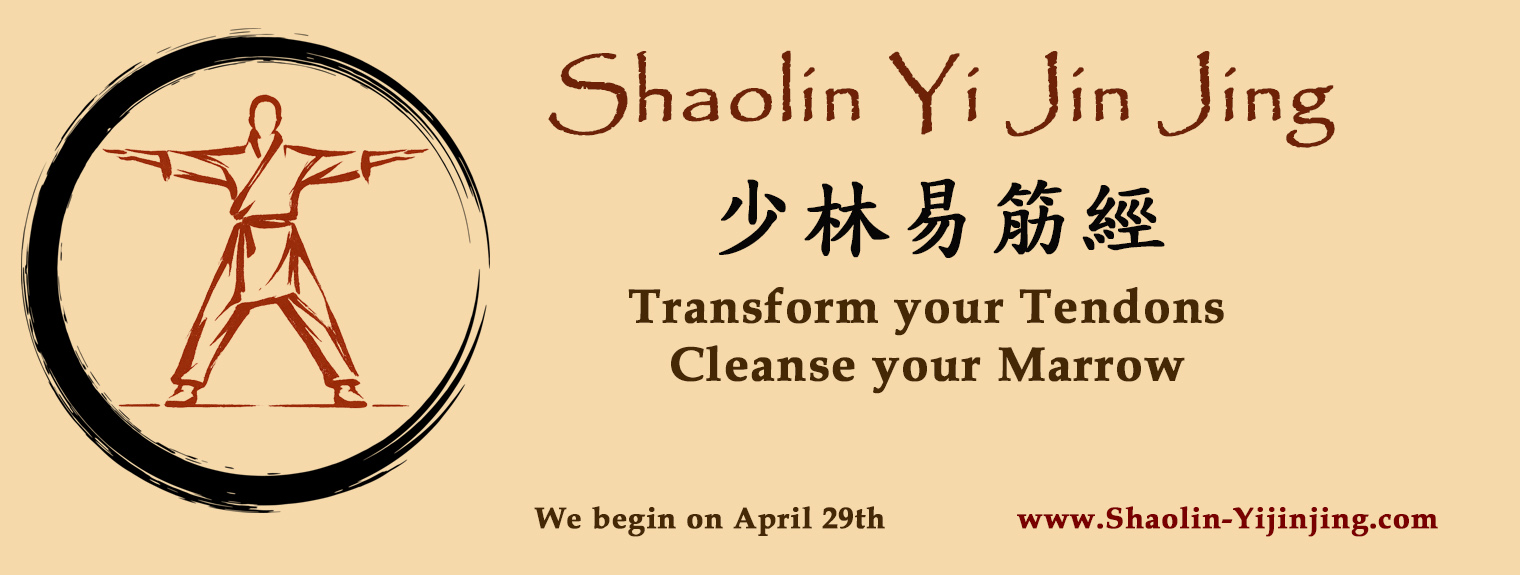
Shaolin Yi Jin Jing - Year One
Review of Fundamental Qi Gong Principles
Review of Fundamental Qi Gong Joint Opening Exercises
Three Yi Jin Jing Forms
12 Gestures of Wei Tuo -
(Passes 1-3 for Pandiculation)
Tan Fu's External Vigor
Passes 1-6 (of 12) Isometrics
Daoist Heavy Hands
The Structure of Stillness and Release (Bone Marrow Washing)
Stone Locks (or Kettle Bells) - one
Gymitations One – Primary Muscles
Yang Sheng - Nourishing Your Tissues
Liniments and Self Massage
Pai Da One – Percussive Massage
Shaolin Yi Jin Jing - Year Two
Three Yi Jin Jing Forms
12 Gestures of Wei Tuo
(Passes 4-6 for Qi, Jin, Gu Yi Layers of Practice)
Tan Fu's External Vigor
(Passes 7-12 for Qi, Jin, Gu Yi Layers of Practice)
Daoist Heavy Hands
(Qi, Jin, Gu Yi Layers of Practice)
Shaolin Seated Wall Staring Meditation - Five Breaths of Yi Nian
Restore Your Core and Floor Work (Dian Gong)
Shaolin Tan Tui – Three Gestures for Leg Strength and Power
Stone Locks - two
Whole Body Nerve Flossing Flow (and individual nerves)
Gymitations Two – Circuit Training – Phase One and Two
Pai Da – Two – Using Bean Bags or Bamboo
Anti-Aging Protocols and Facial rejuvenation Massage
(Mobile Cupping and Gua Sha)
Clay Pot Carnivore Diet – Cookbook and Webinar
Shaolin Yi Jin Jing - Year Three
12 Gestures of Wei Tuo
(Fifth Pass - Melting Body into Stillness)
Tan Fu's External Vigor
(Jing/Gel Body and Light Body Conversion and Inversion)
Daoist Heavy Hands
(Metal to Air, Water and Soil, Mercury and Lead)
Five Animals Old and New - Pre-recorded
Yang Sheng Fa– 10 Week Cleansing, Rejuvenation, and Longevity course – Pre-recorded
Nei Gong - Meridian and Dan Tian Essentials of Nei Gong Year One
Stone Locks- Phase Three – Tabata Training
Gymitations three – Tabata Training
Rearranging and restoring the structure and function of all of your connective tissues and circulation, and all of your meridians is like building a city. From the ground up. These practices are demanding, very high level, and are only taught when people are ready for this degree of Mind, Body, Meridian, Jing, Connective Tissue (Jin), and Breathwork transformation.
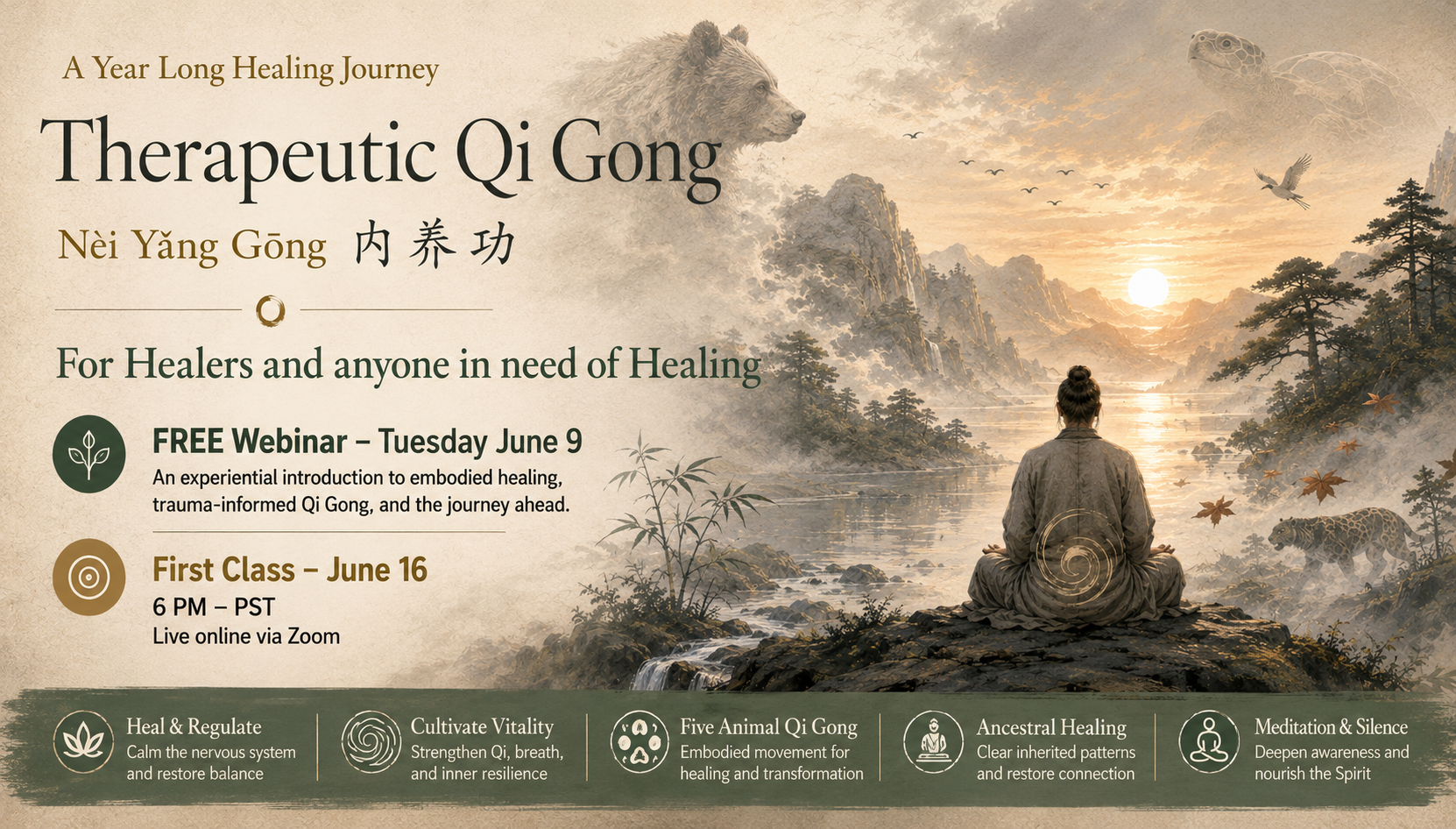
Therapeutic Qi Gong
A Year Long Healing Journey
Intro Webinar – June 9, 2026
Course begins June 16 – 6 PM – PST
Healing is a need for everyone – at some point, in some way.
Sometimes, we need support from others, and most of the time we need to find it within ourselves to commit to our own healing.
Healing asks us to relax deeply; however we get there, and then go inward and feel what has changed. What is wounded, and where can we find the adaptability to learn and grow – again?
Healing also asks us to allow ourselves to finally feel what we need.
This is felt on many levels, including your Qi field, your intuition, and other internal systems of embodied awareness.
Therapeutic Qi Gong involves learning and practicing a system of embodied and energetic Self – Healing
This includes gentle exercises, meditation techniques, personalized breathwork practices, animistic shape-shifting practices, and Self-Healing Qi Gong skills.
This course is meant for those in need of a Self Healing practice, and those who guide others as a Healer.
The most important aspects of life are felt!
We seek excitement and pleasure because they mean we are adapting to life, finding solutions, restoring what is fractured, celebrating moments, and feeling our birthright of playful confidence.
The process of healing asks us all to come back home to our lives. This means feeling through, and energetically transforming wounds, embodied patterns, emotional turmoil, and a low-grade kind of shock. All of the energy caught up in latent patterns is now free to be felt as aliveness and a source of whole-body regeneration.
It does not take long for one’s Qi to become strong and one’s Spirit to become more radiant.
I am interested in learning more about becoming a Qi Gong Teacher and/or study advanced Qi Gong in a traditional lineage and would like to receive your newsletter.
YES! Send me a copy of the Student Resource Guide
(We respect your privacy)