Learning Qì Gōng begins with a few movements, settling into good alignment, breathing with curiosity, and giving your attention a chance reunite with your embodied experience. After learning the fundamentals, most Qi Gong practitioners learn a few traditional forms and find a regular personal practice that is familiar and restorative.
For some, that journey meets all of their needs and sustains them over a very long life.
For others, there is a knowing that there is a lot more going on, and follow that yearning. Following a yearning for a deeper connection to the energetic and subtle, can go in a lot of different directions, so it is good to have a map.
The internal cultivation traditions, like Nèi Gōng and Nèi Jiā (the Internal Chinese martial arts), carry such a map.
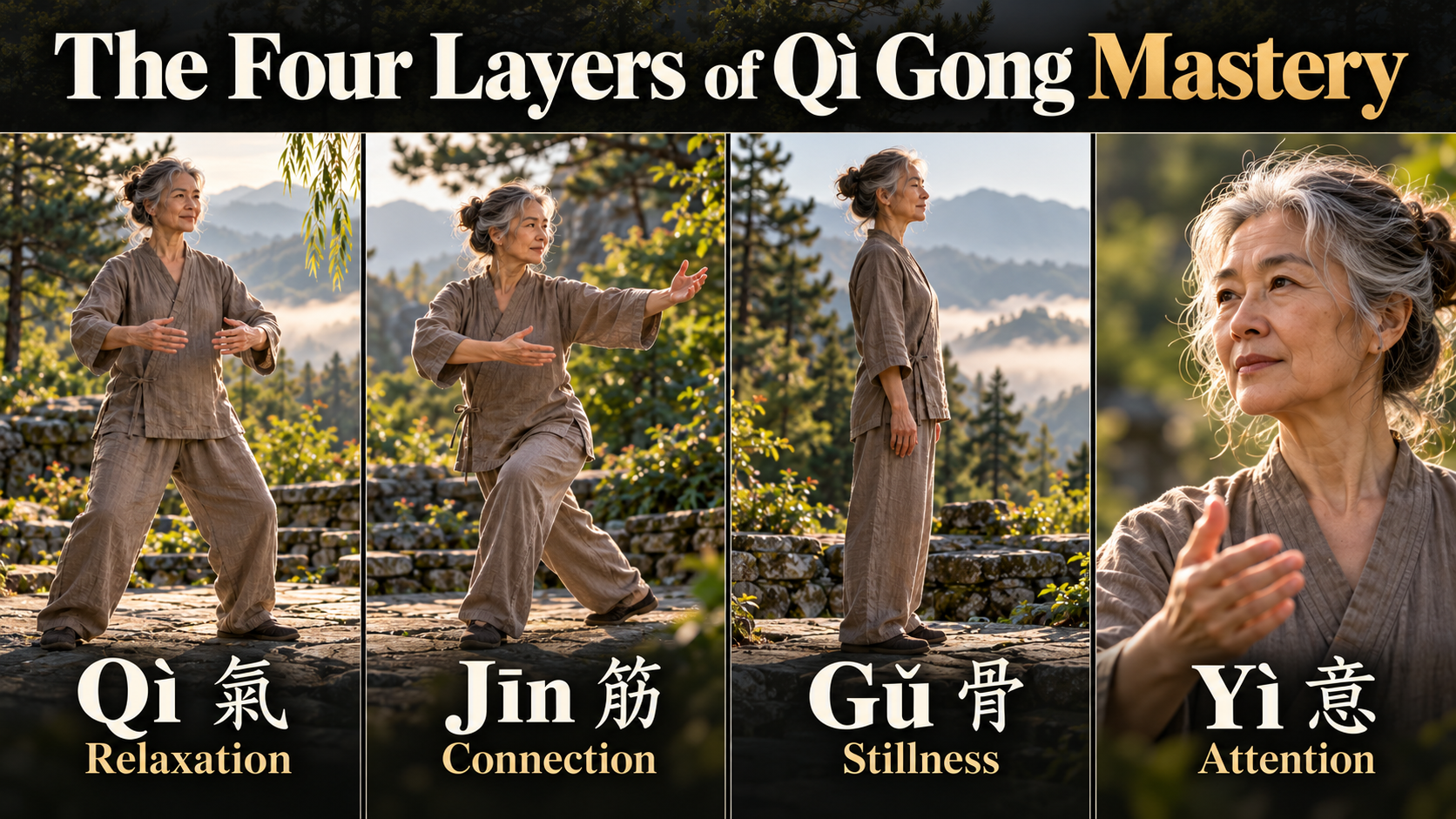
We call it the Four Layers ~ 四層 Sì Céng : four distinct dimensions of embodied experience that can be cultivated, refined, and transformed in their own ways, and eventually integrated into a unified whole. The same simplest movement, the same standing posture, can be practiced for decades, and it will keep revealing new depths, because you practice it in entirely distinct ways, over and over.
You are on an ancient journey of reunion with your embodiment and awareness – with a very clear map.
Your Qì Layer
氣層
Reflex, Aliveness and Learning to Let Go
Qì Céng, your Qì layer, is your innate level of sensitivity, reflex, and interaction. It is that alert and instinctual layer of your nervous system. Your innate energetic systems and connection can help you duck, or flinch, or bust a killer dance move, or practice Tai Chi with expressive movements. This layer or level kept your ancestors alive without thinking at all.
This inner agility and playfulness can also create and hold a great deal of everyday tension.
So, the first essential skill is relaxation, though not in the way most of us imagine it. The Chinese term is Fàng Sōng 放鬆: soft, elastic, resilient.quality that plays with the edge actively opening your joints and membranes and releasing them into a completely pliable and loose quality of movement and stillness.
In every practice session, between exercise or gesture, it is advised to pause into a balanced structure and an attitude of relaxed readiness. (The word attitude means two things: your position in space, and your approach to Life. Both apply.)
One old image for the character Fàng 放 expresses pulling out your hairpin and letting your hair fall and fly loosely in in the wind. In imperial China, a hairstyle displayed rank, so letting it down meant setting aside status and the rigid identity that held you in place. T
That is what Fàng Sōng asks of your whole body and Being.
Try this…
Stand with your legs straight. Notice how your energy feels. Where do you feel heavy, or tense, or collapsed? Where do you feel your strength, humor, and spark of life?
Now soften your knees into a slight crouch. Move around and settle until you feel ready to dance, play, run, stalk or, if needed, fight. The Qi Layer of practice encourage us all to find a connection with embodiment and awareness that prepares us for all possible outcomes – especially the good ones.
In Chinese medicine, that responsiveness through your legs reflects the energy of your Kidneys, the root of your adaptability.
Inhabit every posture so completely that any reflexive instinctual guarding begins to unwind on its own. Your Kidneys will thank you!
Your Jin Layer
筋層
Coordination, Connective Tissue, and Whole Body Interaction
Once you have relaxed and opened your natural holding patterns , your connective tissues reawaken and seek whole body interaction and coordination.
Jīn Céng, the tendon or connective tissue system layer, is the world of your muscles, tendons, ligaments, membranes, fascia, and interstitial fluids and gels that contract, stretch, store elastic energy and absorb impact.
The long term goal is whole body tensegrity through myofascial restoration. Notice that your entire skeleton ‘floats’ within a continuous web of elasticity and tone, rather than stacking like bricks that hold you up. The old masters didn’t use the same words, they trained their bodies as meridians and instincts arising from an infinite source of energy and aliveness.
At this level, you stop moving your body as separate parts, and begin moving as an integrated and dynamic system of sensation, state, and playful curiosity. The concept of moving from your center becomes a tangible reality,and the TCM description of Qi circulation being rooted in your infinite web of tissue filaments (Jing Jin – meridians) , blood and lymph vessels, and extracellular fluids becomes the landscape of cultivation.
Two images help here. The willow is pliant but never floppy; the wind lengthens every fiber while the roots keep returning the tree to grounded rootedness. The pine is rooted in readiness, able to bear weight and the dynamic or storms without breaking. Yield like the willow, hold inner connections like a pine tree.
And a principle teachers should say every class -“Build your inner network of tissue connections (myofascial tensegrity) before you train for explosive momentum – Fa Jin. Any movement that freezes at its end, like punching full speed at the air, sends forces rebounding into your joints, neck and spine. Impulse without a receiving structure is simply training to put on the brakes to avoid deeper damage.
This layer asks for patience, and the patience is physiological. Muscles can change in a few weeks. Your deeper connective tissues to change takes months, and the more dense structural tendons and ligaments can take a couple of years.
It is a worth while investment because the tissue transformation (Yi Jin Jing) can last for decades.
Your Gu Layer
骨層
Bones, Stillness, and Memory
Then we arrive at Gǔ Céng, your bone layer. This is where you explore structural alignment and spacial awareness, while feeling your skeleton – your spine, your pelvis, limbs and skull all floating in the filaments and gels that make up most of your physical body.
It is almost impossible to experience your individual bones, settling into their innate alignment and positions while carrying a lot of nervous tension or postural imbalances.
Here’s a simple example from martial arts, though this course isn’t about fighting. If you ball your hand up into a tense fist, the stiffness in your hand wrist limits how freely your elbow can move. unnecessary tension blocks the very force it you may be trying to create. When you can feel, imagine, and carry the bones of your forearm and hand moving cleanly through space, there is less resistance.
Try this…
Wiggle your forearm until you can feel one of those bones. Now, with almost no effort, imagine gently squeezing the ends of that bone together, from wrist to elbow, like closing a small accordion. Inhale. Then, slowly exhale, letting the ends drift apart, farther than seems possible, as if the bone itself were lengthening.
A little pressure, and then a really long release.
In Chinese medicine, your Kidneys, bones, and marrow are where certain memories are said to be held. The classical practice of bone marrow washing is, at its heart, a body of animistic strategies for letting old ‘bone weary’ grudges and inherited burdens seep out of your skeleton.
You cannot make that happen. Stillness becomes the home of a deeper practice.That stillness is only found through very subtle motions and releases.
Over time, your Bone Layer becomes a seated or standing embodied meditation that is directly anchored in your experince of gravity, tone, release, and time.
This is the entry into cultivation of Interactive Awareness (Yì 意), Spiritual Alignment and Resolve (Zhèng 正), and Coherent Tranquility (Qīng Jìng 清靜).
Your Yì Layer
意層
Between Attention and Intention
Finally, there is your Yì Céng, and it is genuinely difficult to describe this experiential potential in English.
Your Yì layer lives in a part of your mind that exists between open attention and the forming of a specific intention. Not thinking or drifting. A very clear interactice awareness before any words arrive.
The tradition gathers three capacities here: Coherent Interactive Awareness (Yì Niàn 意念), One-pointed Embodied Stillness (Yī Zhǐ Chán 一指禪), and Innate Self Perception (Zì Rán 自然).
In Chinese medicine we say “Your mind (Yi) leads Qì, your Qì leads the blood, and this whole body collaboration guides every quality of movement.”
At the Yì Layer, you are living experince in practice and in daily life. There is no way skip ahead. To move this way, you must be well developed in your Qì, Jīn and Gǔ layers.
A Ladder and a Compass
The layers are often taught as a progression, and that is a natural developmental arc.
You can’t easily feel the subtlety of your bones while still managing significant reflexive tension, and you can’t move as conscious perception (Yì) without first integrating the three physical levels of perception.
They are also explored like the many directions on a compass. At any moment, in any practice, you can check in: Where is my reflexive guarding? Are my inner connective tissues connected, before my external reflexes are tested?
Can I feel my inner spacial and structural dynamics and skeleton?Am I in a coherent state, of is my attention still a slave to distraction?
Once developed, each layer informs and supports the others, in every movement, in stillness, every day.
For Those Who Teach, or are learning to
If you teach, or feel the called to, the Four Layers solve the most persistent problem in our field: how to keep students progressing without adding more on the outside that the inside.
A complete system doesn’t need hundreds of forms. It needs a handful of practices revisited, layer by layer, with a clear sense of what each pass is for. The same standing posture is a reflex-unwinding exercise in the first year, a connective-tissue laboratory in the second, a skeletal meditation in the third, and a training ground for attention after that. Students never run out of practice, because the practice never runs out of depth.
The layers also give you a diagnostic eye. When a student’s posture looks strong but their neck is guarding, the outside body has outrun the inside body. When a student is technically precise but anxious, they are trying to work at the Jīn or Gǔ layer while still caught in the Qì layer. You don’t have to guess what they need next. You can see which layer is asking for attention.
And keep the work alive. Start the old way, then play; practise in order, at random, or take one piece and make it a whole exploration. Neuroplasticity loves novelty, and so does the Spirit.
Where to Begin
The next time you practice anything, any qìgōng, a walk, even standing in line at the grocery store, have a somatic chat with your Four Layers (Sì Céng).
Feel your reflexes soften. Feel the connections between your feet, core, spine, and your tongue. Feel the quiet architecture of your bones. Then, without trying, notice the clear, wordless direction of your attention.
There are other layers still, but they are best left for when your teacher tells you it is time.
Which brings me to the most important advice I can give: find a teacher who has been guided through this themselves, step by step.
A map is a wonderful thing. A guide who has walked the territory is better.