The Art and Craft of teaching Qì Gōng
There is a moment, when learning Qi Gong stops being something you do with your thinking mind and becomes something your whole body explores, plays, and sings.
You start listening, with your skin, your breath, your eyes, your Heart, whole Body and Being. At this point in practice, we all need an experienced guide on our inner explorations, a coach on the ways we play with energy and awareness without getting injured, and some traditional songs while you learn the old ways and discover your innate potential.
I want to talk with you today about that moment, and about the need for several kinds of classes that ensure a complete practice, understanding, and experience of a vast and ancient tradition.
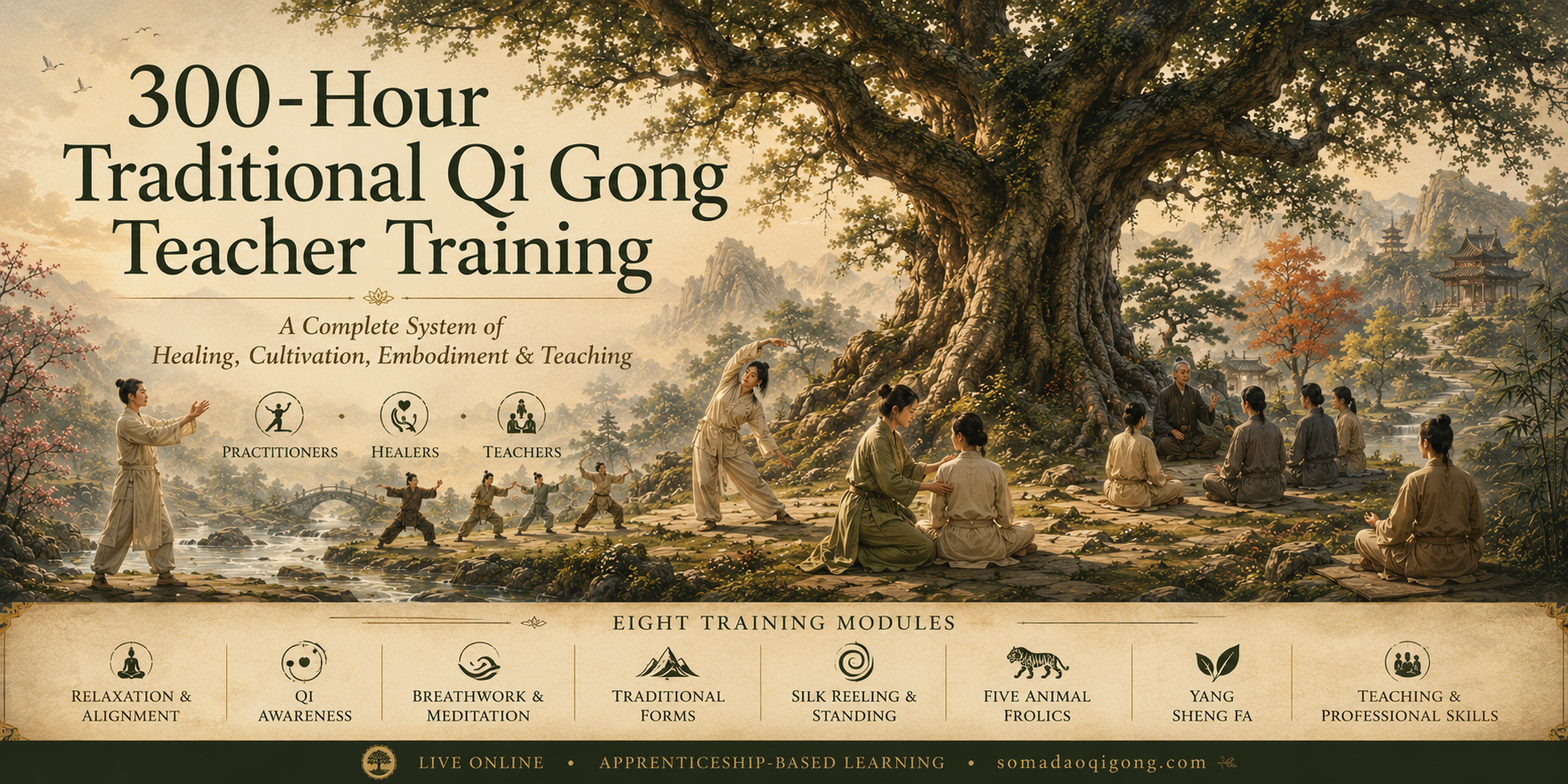
If you feel even a calling toward teaching Qì Gōng 氣功, the best way to learn is to take a curious look at how teaching a complete system usually unfolds.
I have been practicing qì gōng, meditation and the internal arts for forty-eight years, and teaching for more than three decades. Over that time, I have noticed that learning something completely requires experiencing it in several ways.
Every Qi Gong gesture begins as simply as lifting and lowering your arms, gently and slowly while relaxing. Over time every gesture becomes an intimate relationship with embodied principles of movement, and how to restore alignment, mobility, coordination, release, flow, and play.
Most Qi Gong gestures are meant to begin from the center, coil through the torso, spiral through the limbs, and express through the hands, feet, and eyes. In a thousand different ways. Learning those aspects of Qi Gong, and especially for those learning to teach this treasure chest of embodied medicine, asks us all to practice in several different ways, exploring our most common needs as tissue bodies, as energy bodies, and as Spirit.
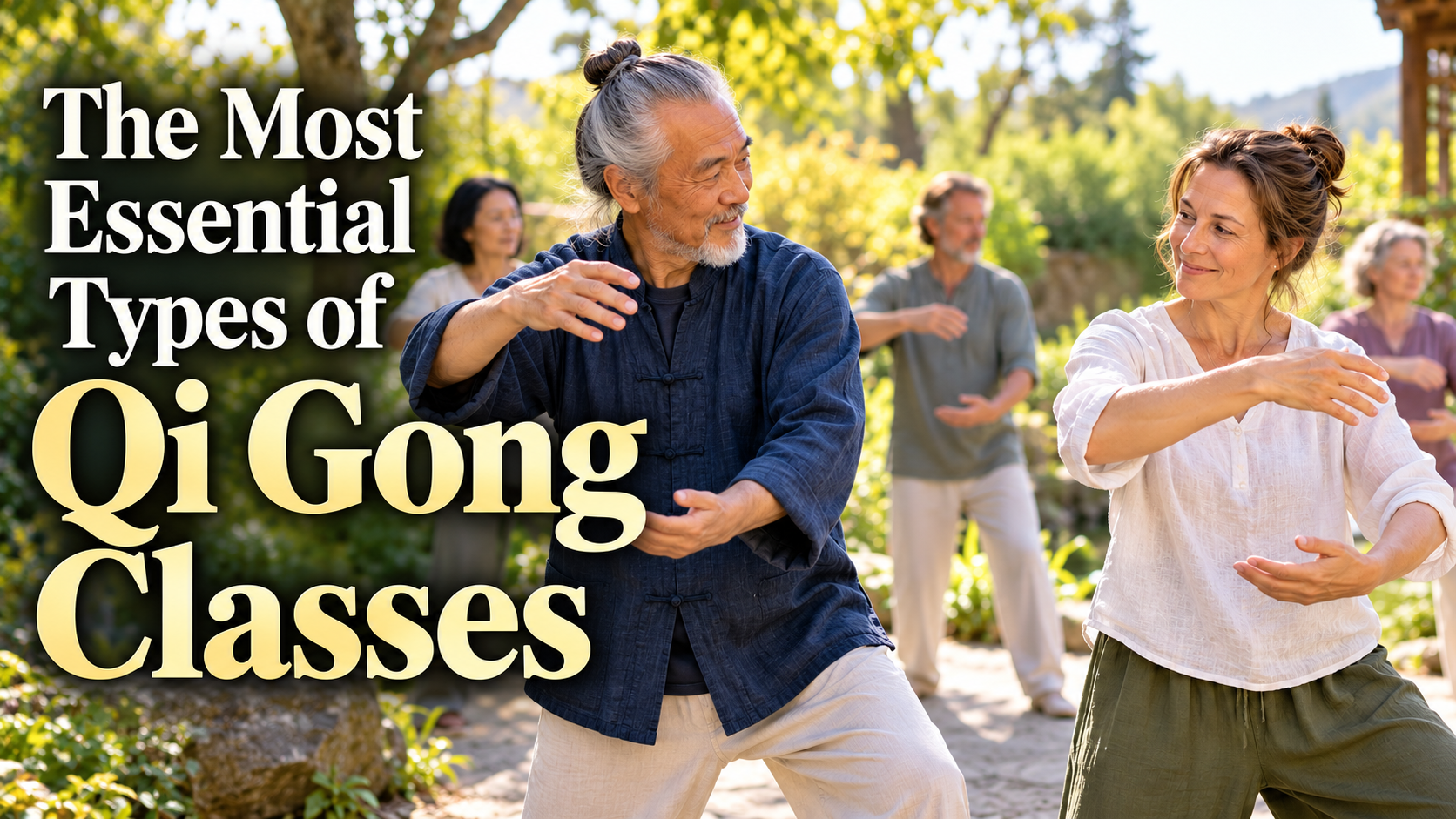
Here are the types of classes that I have seen help people progress the most consistently, and why.
The Silent Class
Let me begin with one of my students favorites. The first type is called a mirror class, or the silent class. Now and then I call it a Chinese class, because for an hour I pretend I don’t speak English.
Many of my own teachers didn’t speak English well, or needed a translator. I often learned more from these interactions, in the way a child learns, by watching, by imitating, by guessing at what they wanted then prying apart symbolic descriptions. And I can honestly say it is astonishing how much you can absorb when you truly choose to mimic, to imitate, and sometimes playfully exaggerate what you are exploring.
There is good reason for this. A great deal of what passes between two people, especially what we feel and how we feel about each other, travels not through words but through tone of voice, facial expression, posture, and the tiny cues we read without knowing we are reading them. We have needed this capacity ever since birth. Neuroscientists have described a mirror system in the brain, networks of structures called Mirror Neurons, that become active both when we perform an action and when we watch someone else perform it. Think of the faces parents make for their babies, and the faces babies mirror back. That playful exchange is one of the first ways we learn what a face means, and what our own face is doing.
It engages the experience of trust, and in a room full of people, synchronizes the bio-electric fields that come from our Hearts
So, in a silent class I simply say,
Ready, set, Be!
Rest your “what if…, where should…, but why…?” brain, and allow your felt-sense embodied mind flow with the learning. And then, because I am hardly speaking, the only thing left for you to follow is my expressive (sometimes exaggerated) qualities of the movement, when momentum is even or dynamic, the feeling I am having on the inside as it shows up on the outside.
There is something deeper here as well. When we feel safe, we can learn. Stephen Porges’ polyvagal theory describes how the nervous system is continually sensing, below conscious awareness, whether we are settled, connected and safe. Over tine that deeper awareness becomes trust, and then even more of the proverbial bandwidth for learning opens.
A quiet room, a shared rhythm, a teacher whose demeanor and affect says you are welcome here, this is what this feels like if you allow yourself to move with the wonder of a child and the precision of a Master.
Exaggeration, Kindness and Play
Exaggeration is one of the most useful tools any Qi Gong teacher can have. It applies to almost every type of class I describe here.
If you were teaching, imagine walking around a room, or watching a group of individuals on a screen. In a room you would walk over to each person who needs a ‘nudge’ of correction. You could then exaggerate each principle and expression of almost every movement, so each student can see what matters. Then, in the kindest possible way, gently exaggerating what each student is doing, so they can see the difference for themselves. A calmly spoken ‘More of this, less of that.’ No lecture. No judgment. Just two people playing, the way children play.
That word, play, matters. In Chinese, if you invite a friend to the park to practice, you might say let’s go play qì gōng, using the same word, wán 玩, you would use for playing guitar or tossing a Frisbee.
Practice should rarely feel boring or serious. When we are smiling and at ease, attention widens, curiosity opens, and your body learns to listen and attune into itself more deeply and more wholeheartedly.
The Guided Healing Journey
A Guided Class is the experience that we all yearn for when we feel out of balance, unwell, or beyond our adaptive capacity. This style of sharing Qi Gong may shift from standing to seated to moving or laying on the floor and back again.
This type of class focuses on a guided sequence of practices and pauses that induce a therapeutic experience. At its most beautiful, this becomes ceremony.
Imagine a group gathering with one shared intention, say, to tend grief. We might begin with a teaching about grief from one of the wisdom traditions, so we have a sense of what we are stepping into. Then forty minutes or so of breath and movement, constraint and release, some quiet mapping of where grief lives in our bodies, how we resist it, how we carry and care for all of our wounds, how we sometimes carry other people’s wounds as our own.
This is wonderful medicine: people gathering, holding an intention, sharing a rhythm of awareness and sensation, feeling how Qì moves and how deeply we are connected to everything around us. It is a great way to introduce yourself to your community as a Qi Gong teacher.
The Skill Development Class
The Third is a Skill Development Class, which is the experience that most people are looking for when they first notice how much every new subtlety expands their Qi Gong universe. Most of the classes in a teacher training fall under skill development, because there are so many important practices and principles to learn in a relatively short time.
A Qi Gong skill development class looks similar to people training in many disciples all over in the world. Whether you are coaching a mixed martial artist, a gymnast, an Olympic fencer or a figure skater, if you want to build a skill and pass it on, there is a method.
I am not suggesting something mechanical and formulaic in the dull sense. But you do need to be able to take any exercise apart: break it into counted sequences, marry those sequences with several forms of breathwork with precision. As the coherence of intention and interaction bring your practice deeper, then it is natural to layer in structure, balance, momentum, torsion, release, state shift, and perhaps even energy centers (Dan Tian), meridians, or Daoist descriptions of one’s mystical inner landscape.
Every skill is built step by step, in an order that makes sense to the person that is learning it. This is the perhaps the most enjoyable and enlivening aspect of teaching – helping each person encounter the next layer or quality in the order that help them learn what they need, today.
As you build a complete practice and consider what you want to teach the most at first. Every exercise becomes a question. How would I share this? Where would I break it? What metaphor would carry the feeling of an experience to someone who has not have felt it yet?
The Rolling Review
The fourth type of class holds the whole process of teaching together. I call this a rolling review, because I think of it like a rolling snowball, gradually expanding as it rolls along.
In our first class, we might spend twenty-five minutes on basic warm-ups. The following week we go through all of it again, more slowly, with more detail and more conversation about the particulars. We might do that a couple more times, adding a little new material each week. After three or four weeks of review, we stop dissecting those first exercises and simply practice them as though we know them, because by then we do, and our attention turns to the next series of practices that illuminate another relationship and quality of interaction.
Within a couple of months, there is enough for a silent class of forty-five minutes or so, where the whole group moves through a complete practice together, confident, comfortable, aware of what is happening, and refining detail as we go.
Then the questions that arise determine the rolling review and expansion for the next class.
On and on through time immemorial…
An Invitation
Come and learn Qì Gōng, not only as a collection of movements, but as a living conversation between your breath, body, aliveness, awareness, wholeheartedness, the natural world around you, and the universal energies pouring through you.
And, if something in you suspects you might one day want to share it, come and learn how to teach it, from the very first day.
For the first year we focus mostly on what to teach. Toward the end of that year we turn to how to teach: breaking things down, finding your metaphors, reading a room, exaggerating with kindness, holding space for a group, and keeping the whole thing light enough that people allowed to be themselves.
And, when we get there, you will find that you have been learning how to teach all along.
The world needs more people who can move well, breathe well, and help others feel at home in their own bodies. Perhaps you are one of them.